The Importance of Rolling Resistance for Fleets
Read more




Rolling resistance can be defined as the amount of energy a tire uses over a defined distance. It is one of five forces – along with gravity, aerodynamics, inertia and mechanical friction – that must be overcome for a vehicle to move forward. There are a number of factors that affect rolling resistance: the design, bead, belt, sidewall, tread and inflation pressure of the tire itself, the load and distribution of the vehicle, the road conditions, and the weather.
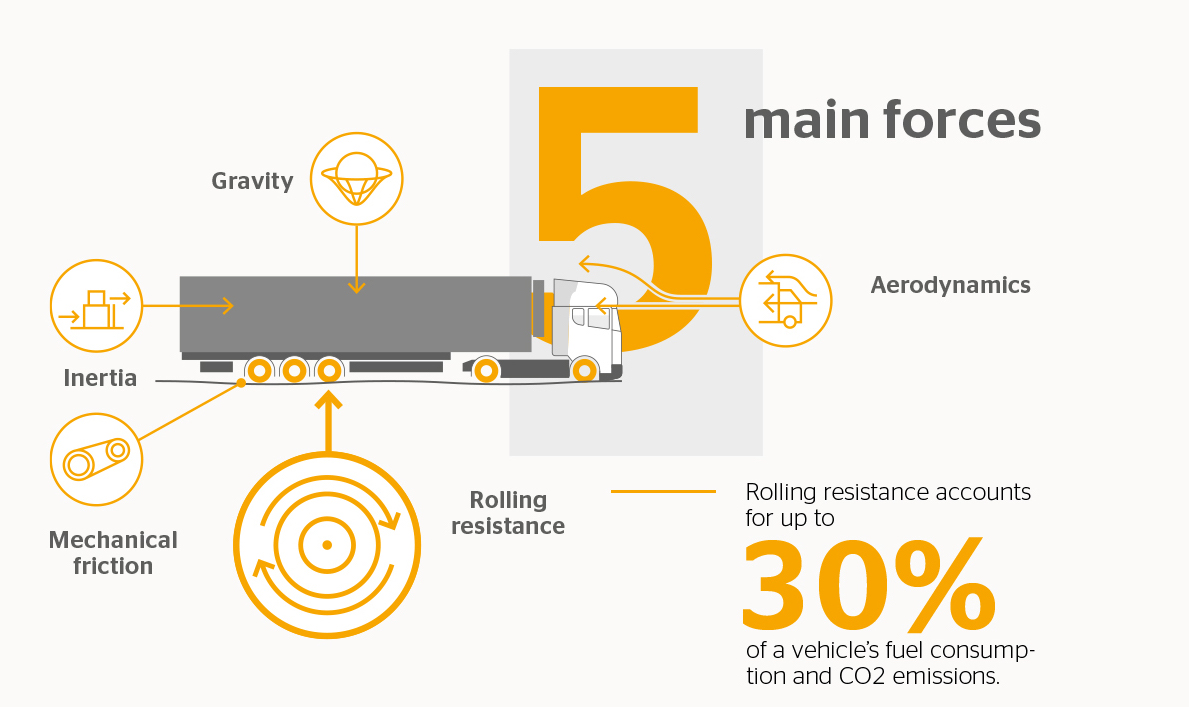
The most significant factor in reducing rolling resistance concerns hysteresis – the process that happens when a tire flexes as it meets the road surface, leading to an energy loss that inhibits forward momentum. Studies have shown that hysteresis accounts for as much as 85-90% of rolling resistance, so reducing it is a key objective. The majority of the energy that is dissipated through hysteresis occurs via a tire’s tread, largely as a result of the compound used. However, other factors, like tire pressure and alignment, vehicle weight, load and distribution, all have their part to play. The more tire pressure falls below its optimal level, for example, the greater the rolling resistance will be. If a tire on a 22.5" wheel is underinflated by 20% from its recommended inflation pressure, for example, the rolling resistance will increase by around 6% compared to a tire with the correct air pressure.

Tire manufacturers invest heavily in research and development to minimize rolling resistance, a key factor in fuel efficiency. Several techniques are employed:

While tire manufacturers play a crucial role, fleet managers can implement additional strategies to decrease rolling resistance and improve fuel economy:

Improving rolling resistance without compromising handling, grip and mileage is a delicate balancing act. Thanks to improvements in technology and production processes, however, reconciling these conflicting targets is possible. There are now a wide range of tires available that use innovative new compounds to decrease rolling resistance while remaining durable, offering high mileage and improving performance in a variety of real-world driving scenarios. The Conti EcoPlus HS3+, for example, has an advanced tread pattern with a low-void design, resulting in less deformation and higher mileage, while also delivering optimized handling, grip and wet performance ideal for navigating hilly, windy regional roads.

Tires have always had a significant impact on everything from reliability and safety to running fleet costs and driver comfort. The fact that they have an important role to play in combating climate change by helping to reduce trucks’ fuel consumption and CO2 emissions is also hardly news. Accordingly, we have always taken inordinate care to produce safe, reliable products that offer the best combination of fuel economy, sustainability and durability.
 The right tires make truck transport more sustainable