Continental Tires
Care, precision and efficiency have made us one of the leading tire manufacturers in the world. Find out more about our company.
Read more





Our tires are high-tech products.
German engineering and precision are part of our DNA. At the same time, we draw on the expertise of our global team. Our culture is built on trust and the belief that success is the result of hard work and rigorous research and development (R&D). Together, these strengths have driven our pursuit of excellence for more than 150 years.
Around 2,000 employees at our R&D sites worldwide work on innovations with one clear goal: to make tires even safer, more efficient and smarter. In technology development, they research new materials, manufacturing processes and product industrialization. In product development, they work across every segment – from high-performance car tires and tires for trucks and buses to digital fleet-management solutions and tailored products for special-purpose vehicles. This expertise also extends to bicycle and motorcycle tires. Whatever the application or market, we strive to find the right solution.

Tire development is about balancing different requirements. The challenge is to improve multiple aspects of tire performance at the same time, even when they work against one another. For example, lower rolling resistance reduces the amount of energy needed to move a vehicle, but it can also reduce wet grip. Similarly, greater grip can lead to increased tread wear. A soft tire compound provides the grip needed for excellent braking in wet conditions, but it also wears down more quickly, reducing tread life. A harder compound, by contrast, increases tread life but provides less grip. That’s why our experts optimize tire performance as a whole rather than improving properties in isolation.
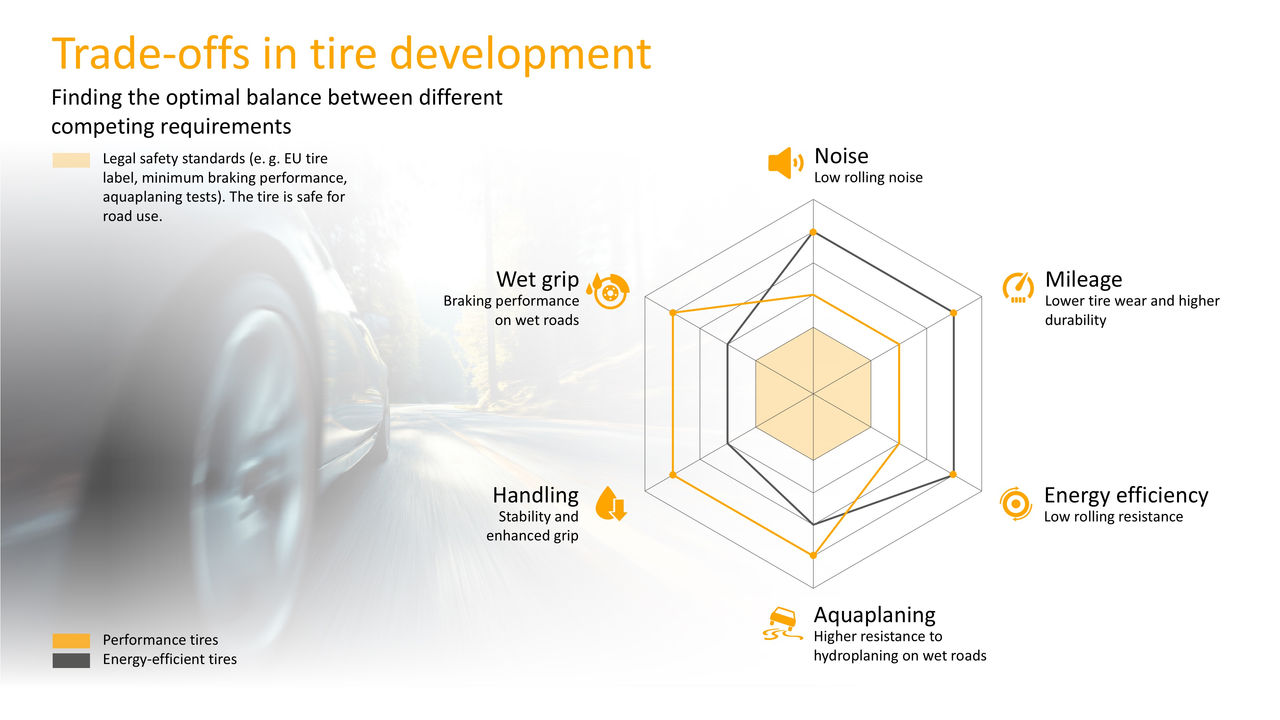
Achieving this balance is key to safety, performance and durability. This makes tire development one of the most demanding disciplines in the automotive industry. Our R&D teams continuously develop new material compounds and tire designs to achieve the best-possible balance for each intended application. Safety always comes first. Every new tire meets all applicable legal requirements and safety standards, which form the foundation of every new development.
After extensive laboratory testing and countless simulations, the moment of truth arrives. Each new tire line is put through over 25 million kilometers of testing on drum rigs and test tracks before they go into production. That’s the equivalent of 625 trips around the Earth. This rigorous testing is the foundation of the premium quality of Continental tires, which automotive manufacturers and drivers around the world have trusted for over 150 years. Read more about tire testing here.
Each test series for a new product is conducted using different tread patterns to identify the strengths and weaknesses of each design. Our innovative testing infrastructure enables a wide range of precise testing and comparison methods, ensuring every tire meets our demanding performance standards.
Professional test drivers are an essential part of the process. Their experience and subjective assessment complement the objective test data, helping our engineers accurately evaluate real-world tire performance.
Regulatory tire tests specify exactly which criteria must be evaluated. These include wet braking, noise emissions, rolling resistance and durability. There are no second chances: every tire must pass these tests the first time.
The inspection and test criteria for summer tires:
Inspection and test criteria for winter tires
is complemented by
Test criteria for All-Season-Tires
The inspection and test criteria for summer and winter tire tests apply to all-season-tire tests
.jpg/_jcr_content/renditions/cq5dam.web.1280.1280.jpeg)