Tire pressure
How to check tire pressure – and why correct inflation is important. ► Learn more about the right tire pressure!
Read more




Whenever you have new wheels and tires fitted to your car – for example, you’ve done the sensible thing and switched between summer and winter tires – it’s essential to have the lug nuts retorqued after the first 50 kilometers.
Why should a responsible driver do this? The point is road safety. Lug nuts keep a wheel securely attached to the hub, which makes them a vital component of the vehicle. But lug nuts can’t perform as designed without having the correct amount of torque applied.

Retorquing refers to checking the wheel lug nuts again after you’ve driven for a while and making sure they’re tightened to the correct level. When new wheels or tires are installed, the nuts are tightened properly, but normal driving can cause them to shift slightly as the wheel settles into place. This settling can reduce the clamping force of the nuts, which means they may not stay at the intended torque level.
Retorquing is done to restore the exact tightness the manufacturer recommends so that the wheel stays firmly secured. It’s a proactive safety step that helps prevent wobbling, uneven pressure, or the risk of a wheel coming loose. By retorquing, you help protect the wheel assembly, maintain safe vehicle handling, and support long-term performance of both the wheels and the tires.
Typical stresses include supporting the weight of the vehicle, the rotational effects of driving, cycles of warming and cooling, and nudges from bumps in the road. Such stresses can cause a slight shift in the seating of the lug nuts, which may result in tightening or loosening.
The presence of dirt, sand, rust, or grit between surfaces such as the threads of the nut or between a nut and the wheel can also create “false torques” during the initial fitting, where the force applied overcomes the friction but doesn’t translate into clamping force.
For these reasons, many car garages and tire dealers will invite drivers to come back the next working day to have their wheels retorqued. It’s a quick procedure, usually offered free of charge, which involves inspecting each lug nut on the wheel to check if they are too tight or too loose.
Loose lug nuts often cause the wheel to wobble or shake, especially at higher speeds or when accelerating or braking. You may also feel vibrations through the steering wheel, seat, or floorboard. Over time, loosening can place extra stress on the remaining lug nuts and wheel studs, leading to uneven wear or damage that indicates something is wrong
Loose lug nuts most commonly occur after a recent wheel installation, tire change, or rotation if the nuts weren’t torqued correctly or the wheel wasn’t seated properly. They can also loosen gradually when driving on rough roads, uneven surfaces, or potholes, as vibrations work the nuts free. Another frequent cause is improper installation, where the initial torque was too low or uneven.
After wheels are installed and the vehicle has been driven for an initial period, a retorque check is often recommended by manufacturers and service professionals. During the first 50–100 km of driving, normal vibrations, load forces and thermal cycles can cause a slight settling of the wheel assembly, potentially reducing the initial clamping force. Skipping this follow-up check may increase the risk of uneven load distribution and mechanical stress over time.
When the wheel is stressed or misshapen, it can throw off the vehicle’s alignment, leading to uneven tire wear and a noticeable decline in handling. This type of misalignment may cause the car to pull to one side, feel less stable, or require more frequent alignment adjustments. In severe cases, damaged studs or a distorted wheel can compromise overall safety, increasing the risk of wheel failure while driving.
With loose nuts, meanwhile, there’s a small risk that the wheel could come off while you’re on the road. The chances of this ever happening are very low – but if it did happen, your safety and that of other road users would be at risk. Driving with a wheel that isn’t fully tightened can also cause additional damage to parts like the hub, studs, brakes, or suspension – which can result in repairs that are much more expensive than simply having the wheels retorqued.
If the lug nuts are too tight, they can cause severe problems such as stripping the fastener threads or stretching the wheel studs. They could also warp the brake drums, rotors, or hubs. In addition to these issues, excessive torque places unnecessary strain on the wheel studs, which can weaken them over time or even cause them to break. Too much force can also distort the wheel itself, creating slight bends or warping that affects how smoothly it rotates.
On the other hand, under-torqued lug nuts can gradually loosen over time, especially when the vehicle is driven over rough roads or under load. That looseness can cause the wheel to wobble or vibrate, accelerate wear on studs and hub components, and in the worst case lead to the wheel detaching from the car while driving.
Retorquing your wheels is a simple but important maintenance step that ensures the lug nuts remain tightened to the correct torque specification after initial installation. By following a proper tightening sequence and using the correct torque settings, you can help maintain even pressure across the wheel and reduce the risk of loosening over time. The following steps explain how to retorque your wheels correctly and safely.
If you want to retorque your wheels yourself, follow these steps:
It’s important to use the torque value recommended in the vehicle’s manual, since the correct setting depends on factors such as wheel material and bolt diameter.
To loosen or tighten lug nuts correctly requires a special tool called a torque wrench.
The mechanic will initially set the torque wrench to half of the required torque and tighten each lug nut according to this setting. Then the setting on the wrench is adjusted to tighten all the lug nuts to the correct torque.
The lug nuts on a wheel are tightened in a specific sequence to provide the proper torque. Lug nuts must be tightened in a crisscross sequence according to the vehicle manufacturer’s specifications to ensure even load distribution and correct torque.
The correct torque for your vehicle’s wheels is specified in the owner’s manual. It varies based on the car model, wheel size, wheel type (aluminum or steel), and the number of lug nuts. Typically, it ranges from 110 N⋅m to 120 N⋅m. If you replace your wheels, the updated torque values can be found in the wheel’s certification documentation.
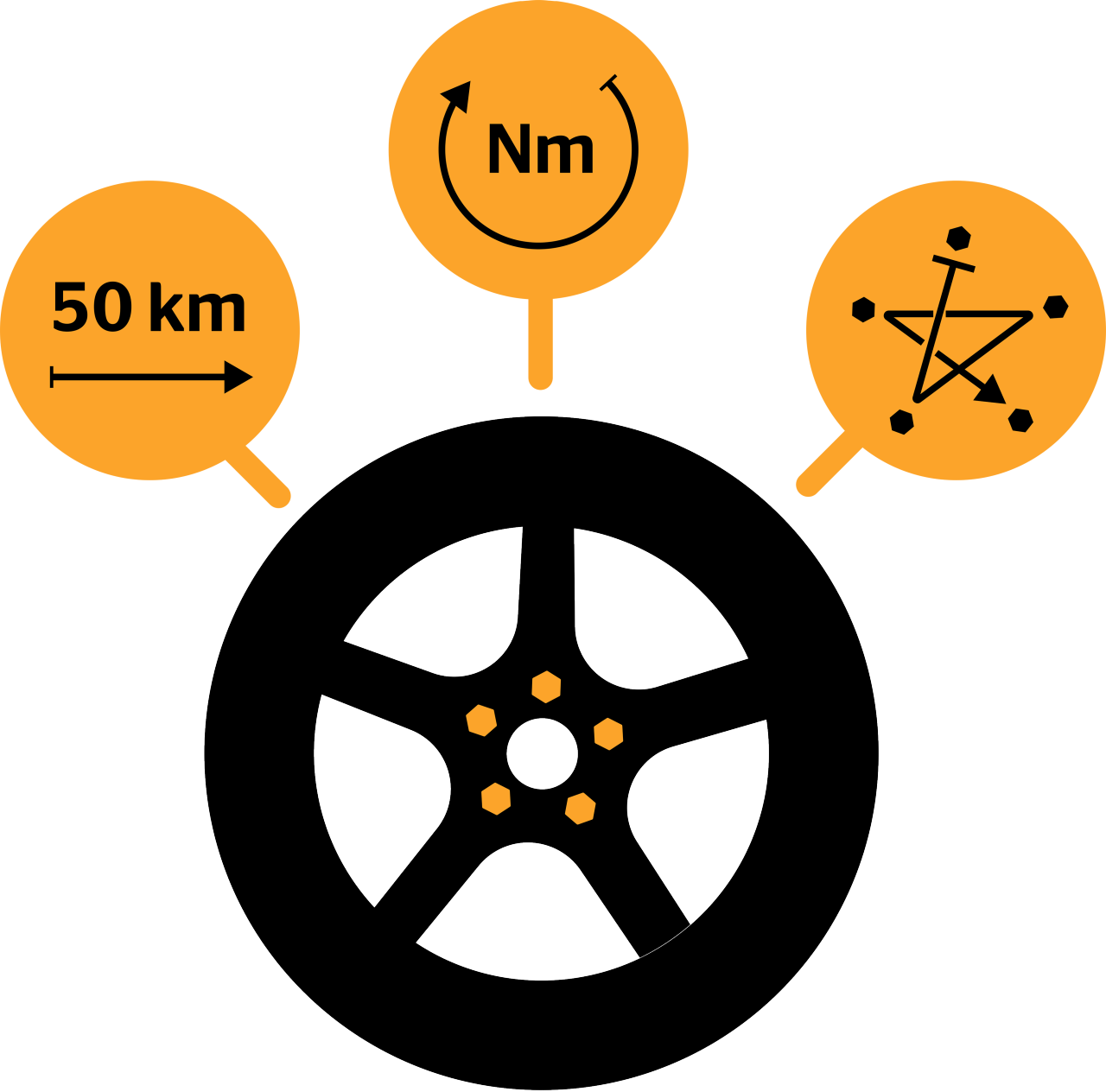
When new or replacement wheels are first mounted, the person responsible must torque the lug nuts according to the vehicle manufacturer’s recommendations. These details are included in the owner’s handbook and vehicle documentation.
After you have driven approximately 50 kilometers on the new tires, the lug nuts must be checked out and, if necessary, retorqued to the same values as before.
Not every car will have the same torque requirements, however. Different makes of vehicles will require different amounts of torque to tighten their lug nuts properly and avoid causing any damage.